

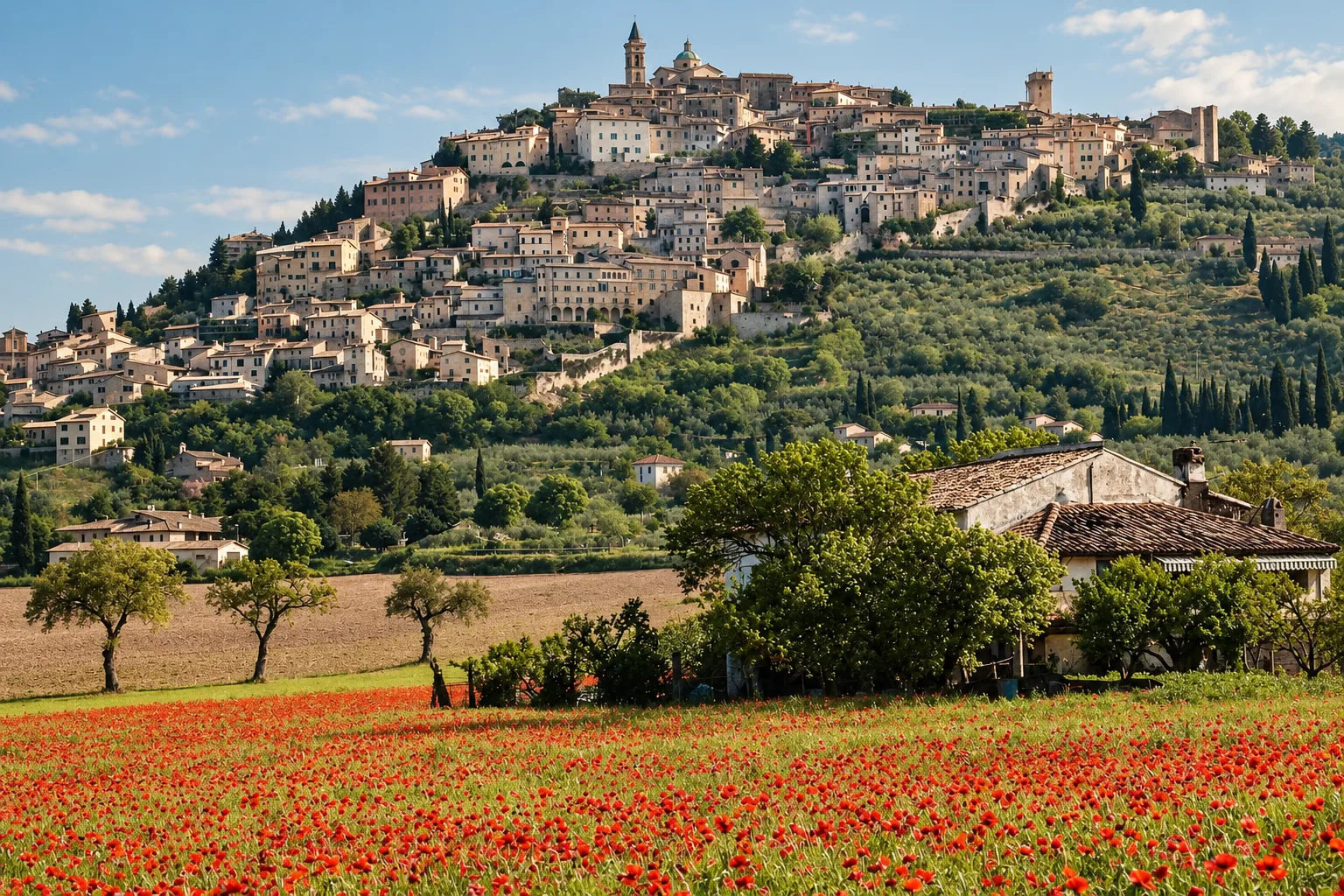
Spiralling up a hillside above a sea of silvery olive groves, Trevi is one of the great names in Umbrian olive oil.
Its tiered medieval streets open onto sweeping views across the Spoleto valley.
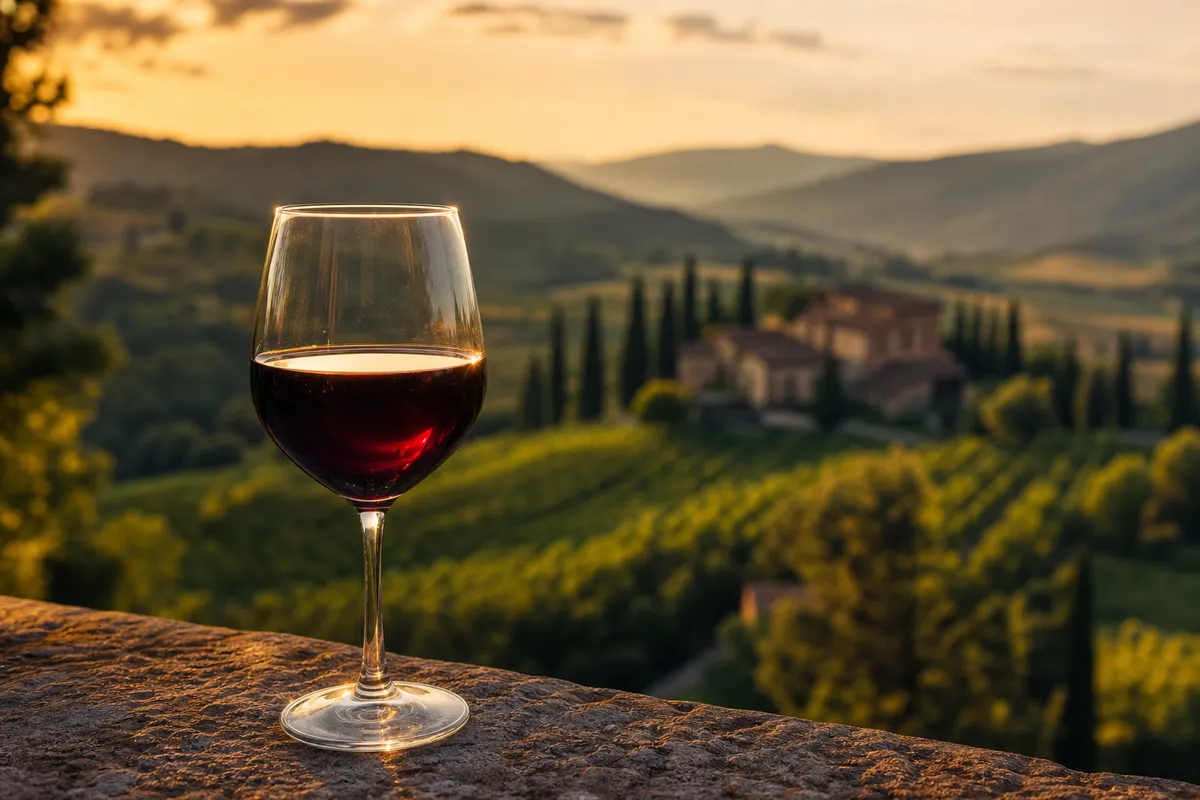
Trevi: a hill town, a valley municipality
Trevi is not only the compact stone town you see stacked above the Valle Umbra. The municipality stretches across about 70 square kilometres, from the plain to the olive-clad slopes and the mountain hamlets, and local planning distinguishes the historic centre, the mountain belt, the hill settlements, the foothill plain and the open plain.
That wider geography shapes a visit from the first minute. The old town sits high on a spur of Monte Serano, while Borgo Trevi and the railway station lie far below. Scattered between them are Bovara, Cannaiola, Coste, Manciano, Matigge, Picciche, Pigge, San Lorenzo, Santa Maria in Valle and Parrano, each with its own character.
The regional landscape inventory describes two linked Trevis: hill centres and olive groves on the slopes toward Campello, and the reclaimed plain toward Spoleto with its fields, waterways and Black Celery. The old town is the best viewpoint over all of it.
Trebiae and the Via Flaminia
The Roman town usually called Trebiae is the ancestor of modern Trevi rather than the same place: an archaeological and historical layer you read in stone rather than on a signpost.
The heritage authority dates the continuous wall circuit around the hill to the first century BC. Down in the plain, finds at Santa Maria di Pietrarossa help trace the Via Flaminia between Spoleto and Forum Flaminii, a road corridor that runs well beyond Trevi's borders.
Walls, gates and the upper town
Trevi's walls are a system rather than a single landmark. Small blocks of local limestone are laid in horizontal courses, and roughly three quarters of the circuit can still be followed. Three openings belong to the Roman wall, while the medieval gates of Bruscito, Cieco and San Fabiano and the Arco del Mostaccio add later chapters to the same walk.
Piazza Mazzini and the Palazzo Comunale anchor the civic heart of the upper town. The level panoramic promenade, a walk of roughly 800 metres, is a welcome counterpoint to the steep lanes.
The San Francesco complex
The Complesso Museale di San Francesco occupies an ex-convent begun in the thirteenth century and rebuilt and decorated in the first half of the seventeenth. Its cloister carries stories from the life of Saint Francis painted by Bernardino Gagliardi. Under one roof you will find the Raccolta d'arte di San Francesco, an archaeological section, the Museo della Civiltà dell'Ulivo and the church of San Francesco.
The archaeological section fills three rooms with Italic and Roman material and grave goods from the Lombard necropolis near Pietrarossa, a neat link back to the valley below the town.
The art collection grew partly through the reorganisation of church property after Italian unification. Official descriptions single out a processional banner of the Madonna della Misericordia, the 1522 Coronation of the Virgin by Giovanni di Pietro, called Lo Spagna, and Alessandro Turchi's Assumption of the Virgin.
The Museo della Civiltà dell'Ulivo tells the story of the olive through panels, archaeological material and oil-making machinery, covering cultivation, processing and the long social history of oil. It is the ideal preparation for the groves outside.
Sant'Emiliano: church, relics and living tradition
Sant'Emiliano is a parish church and a living place of worship, part of the Pievania of Beato Pietro Bonilli alongside other parishes of the Trevi area.
The archdiocese presents the life of Saint Emiliano as hagiographic tradition: an Armenian bishop with a mission to Trebia Matusca, who died a martyr. It is devotional history, told as the community believes and commemorates it.
Each January the town honours its patron with a procession of the statue after vespers. The linden-wood statue is a work of 1753 by Pietro Epifani of Foligno, and the archdiocese says the relics lie beneath the high altar, with a stone marker tied to their reported discovery in 1660.
Madonna delle Lacrime and works in place
The sanctuary of Madonna delle Lacrime stands just outside the tight upper core. Regional interpretation ties its construction to a devotional image and a reported miracle of 1485, with completion in 1522. It has a Renaissance portal by Giovanni di Giampietro and chapels decorated by Perugino and Lo Spagna, including Perugino's 1521 Adoration of the Magi with Saints Peter and Paul.
Some works in the San Francesco collection come from church settings like this one, so the sanctuary and the museum make a natural pair.
The Lex Luci stone from Picciche
One of Trevi's most intriguing objects now lives elsewhere. The National Archaeological Museum in Spoleto holds two limestone cippi inscribed in archaic Latin with the Lex Luci Spoletina, rules and penalties protecting a wood sacred to Jupiter. One turned up in 1879 at San Quirico in Castel Ritaldi. The other was found in 1913 reused high in the old church of Santo Stefano at Picciche, within Trevi.
Both originals are displayed and interpreted in Spoleto, so Picciche is the story of the discovery rather than a place to see the stone.
The historic archive
Trevi's historical archive preserves municipal papers from before and after Italian unification, along with the archive of the Madonna delle Lacrime convent.
The olive landscape: FAO, national register and ecomuseum
The olive slopes between Assisi and Spoleto were designated a Globally Important Agricultural Heritage System by FAO in 2018. FAO points to traditional terraces, local olive varieties, family farming, biodiversity and careful soil-and-water management. Trevi shares this landscape with neighbouring municipalities.
The story runs deep: FAO notes olive pits in Etruscan graves from the seventh century BC and Roman oil mills of the first century AD still visible in the area. The slopes hold three kinds of terrace, dry-stone walls, earthen banks and dry-stone lunettes, between about 200 and 600 metres. The main cultivars are Moraiolo, Frantoio and Leccino, and growers still harvest by hand with nets and prune to an open-centre shape.
Across Umbria, the olive sector covers about 27,000 hectares and roughly 5.5 million trees, with 270 mills turning out between 5,500 and 11,000 tonnes of oil a year.
The same belt entered Italy's National Register of Historic Rural Landscapes in 2018, promoted by a group of municipalities that includes Trevi, Assisi, Spello, Foligno, Campello sul Clitunno and Spoleto.
Trevi's Ecomuseo del Paesaggio Olivato e dell'Olio covers an olive area of about 20 square kilometres, climbing from the valley floor and encircling the historic centre.
Umbria PDO and Colli Assisi Spoleto
Umbria is a protected designation of origin for extra virgin olive oil, and labels carry one of five geographical mentions. The Colli Assisi Spoleto mention takes in the whole municipality of Trevi and calls for at least 60 percent Moraiolo, with Leccino and Frantoio together up to 30 percent and other varieties up to 10 percent.
Black Celery of Trevi
Sedano nero di Trevi is a recognised traditional agri-food product of Umbria and a listed national agricultural biodiversity resource. The regional sheet gives Trevi as its production territory and describes seedbed sowing in April, transplanting in May or June, blanching from the second ten days of September and harvest from mid-October into late December.
It grows in the reclaimed plain, not on the hilltop, which makes it a good reason to come down from the old town.
Clitunno neighbours
The Clitunno waters help explain the plain, its farming and the easy movement between Trevi and its southern neighbours. The Tempietto sul Clitunno, however, stands at Pissignano in the Comune of Campello sul Clitunno, as part of the serial World Heritage property The Longobards in Italy. Places of the Power.
Arrival and on foot
Trevi's railway station lies in the lower valley rather than at the gates of the old town, so the climb to the historic centre is a separate step from the train journey. Check with the rail operator and the municipality before you go.
The municipality lists the Sentiero degli Ulivi, walks among rural churches, ridge routes and the Assisi-Spoleto cycle route. In the old town, steep streets, stone paving and stairs set the pace.
More of Umbria

A letter from Italy, once a month.
The places, tables and makers we found worth your time. One email, no noise.
One letter a month. Unsubscribe at any time. We never share your address.