

Monte Castello di Vibio in brief
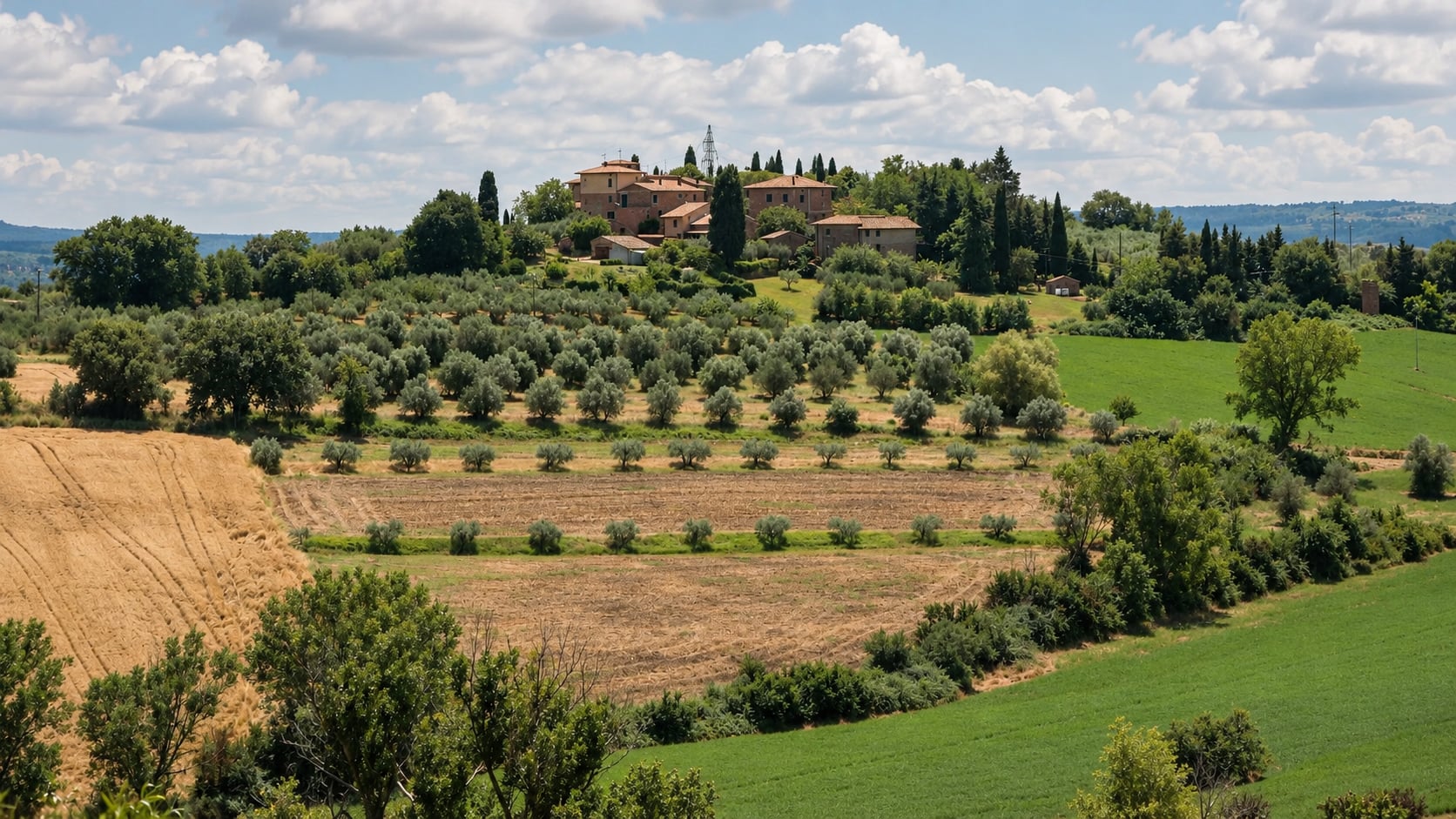
Monte Castello di Vibio is a small hill town in the province of Perugia, Umbria, set on a hilltop of about 422 metres above the middle Tiber valley and laid out in the shape of a heart.
Its municipal statute names the capoluogo, the walled historic centre where the town hall sits, and two frazioni, Doglio and Madonna del Piano. The municipal territory covers roughly 32 square kilometres of hills above the river.
The pleasure of the place is its compactness. A surviving medieval gate with a lookout tower, a miniature historic theatre, two churches with their own small collections of painting and devotion, and a wide view over the Tiber valley sit close together inside the old walls. Around the town the hills belong to several protected wine and olive-oil zones.
The walled hilltop and Porta di Maggio
The old village was entered through two gates, Porta Tramontana and Porta di Maggio. Only Porta di Maggio survives, and its restored tower is a viewpoint over the Middle Tiber landscape.
The gate wears flat, Guelph-style battlements, which the municipality reads as a sign of the town's old status as a papal feudal holding.
The tower is also a small repository of local memory. The municipality describes four muzzle-loading rifles from 1822, probably carried by eight local Garibaldini, a handwritten letter from Giuseppe Garibaldi dated 1862, Roman weights, stone cannon balls, medieval holy-water basins and helmets from the First World War. It is a modest but touching collection, the kind of thing that tells you how a small Umbrian community saw itself in the story of unified Italy.
Teatro della Concordia, the pocket-sized opera house
Teatro della Concordia, on Piazza del Teatro della Concordia, is a working Italian-style historic theatre with just 99 seats: 37 in the stalls and 62 in two tiers of boxes.
The building is often billed as the smallest theatre in the world. The claim is best taken with a smile and a footnote. The theatre's own documentation admits that other theatres with fewer than 100 seats exist, court theatres for instance, and says Concordia earns the title because it is a complete miniature of the great Italian theatres, with a bell-shaped plan, a proper proscenium, frescoed surfaces and all-wood construction. What you get is the full grammar of an opera house at the scale of a drawing room.
The two rows of boxes stand on nine columns, entirely in wood, which gives the room its warm acoustics. There was a democratic touch from the start: no family owned a particular box, and every month each family moved to a side box so that everyone took a turn at the central view.
Nine families, two Agrettis and a long sleep
The idea took shape in the years after the French Revolution, and the name Concordia nods to the spirit of concord among nations that the founders admired. Nine leading families wanted a place for entertainment and conversation, even a coffee lounge, and they made it small on purpose, to the scale of their village. A document from around 1800 is quoted as saying that civility is not measured in volumes or square metres.
Nine local families financed the theatre, inaugurated in 1808. The decoration came later in layers. Cesare Agretti, a painter who loved spending his holidays here, began painting the fronts of the boxes in 1861, choosing clasped hands as the emblem of concord for the central one, and gave the stage a backdrop showing the town of his day.
In 1892 his fourteen-year-old son Luigi Agretti came to fresco the ceiling and foyer. On the foyer stair he painted a foreshortened view of the medieval walls, a nice reminder that the theatre was always meant to belong to the village around it.
The theatre closed in 1951 as unsafe and stayed shut for 42 years. The municipality began expropriation in 1981, and after seven years of works the restoration was completed in 1993, keeping the original wooden structure of the boxes and the frescoes. The restoration belonged to a wider Umbrian effort: the region began recovering its historic theatres with national funds in 1984, and Concordia was among the theatres included, then reopened with European Community financing. It reads today as a layered historic theatre rather than an untouched 1808 interior, and all the more alive for it.
Two churches in the village
Santi Filippo e Giacomo is the parish church and a working one. It reopened for worship after post-earthquake repairs. Regional sources describe an 1851 neoclassical building of three naves, with frescoes by Nicola and Federico Benvenuti, and the municipality adds paintings by the Roman artist Mario Barberis dated 1943 and reliquaries of Saints Philip, James and John the Baptist.
Santa Illuminata, also known as Santissimo Crocifisso, was completed in 1839. Its treasure is a fifteenth-century Spanish wooden crucifix, which local tradition says was donated by Blessed Placido, under a vault frescoed by Luigi Agretti in 1903, eleven years after his work at the theatre. Part of the funding came from the Holy See, because the church had originally been meant to be built in Rome, near San Giovanni in Laterano.
In the early nineteenth century, the municipality notes, records counted about 3,500 residents, enough that the parish church had to be enlarged to hold its congregation.
Both are places of worship first, so visit as you would any village church: quietly, and with respect for services.
The Tiber landscape below the town
Monte Castello di Vibio is one of the municipalities within the 7,925-hectare Tiber River Park, whose regional guide begins its river story at the Montemolino bridge. That does not put the whole municipality inside the park, but it explains the green, slow river country you see from the tower.
The regional Natura 2000 register also links the town and Todi to site IT5210054, Fiume Tevere tra Monte Molino e Pontecuti, a 154-hectare protected area along the river.
Olive oil, wine and protected foods
Monte Castello di Vibio falls inside the production territory of Umbria DOP olive oil for the Colli Orvietani mention, so a bottle from the town's groves can carry a recognised regional name.
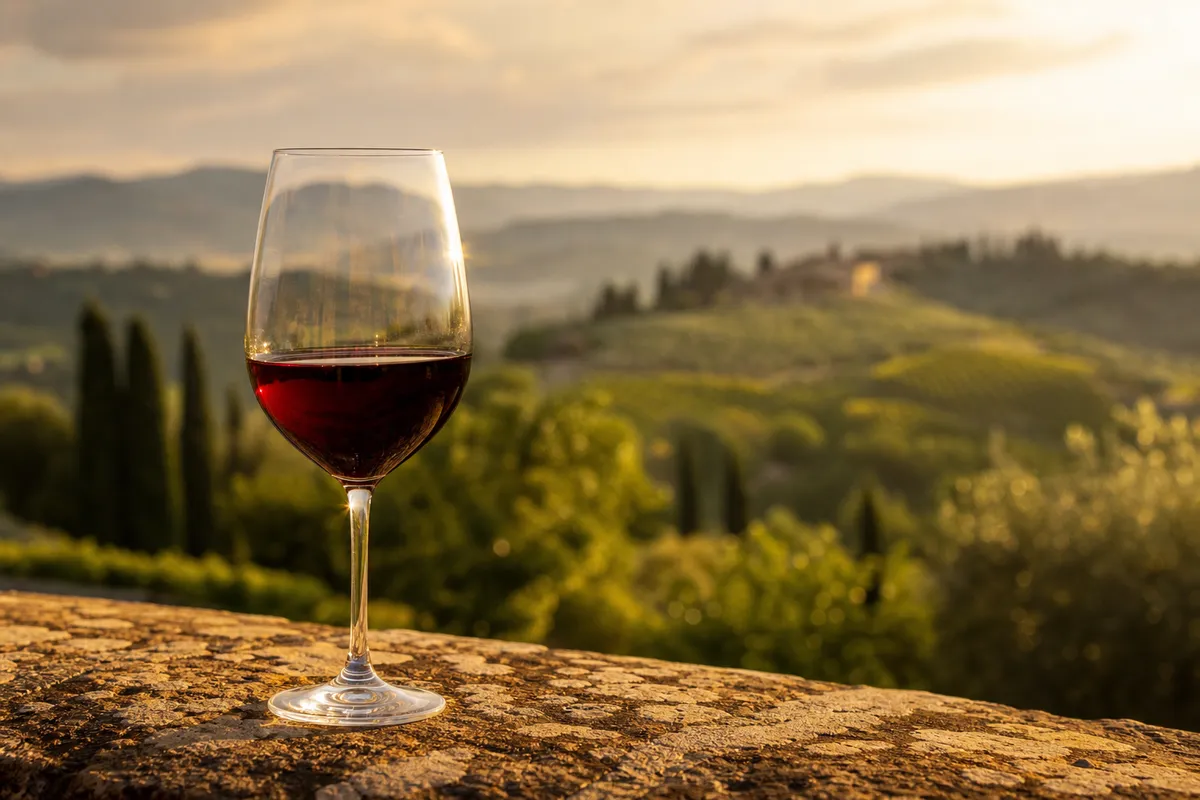
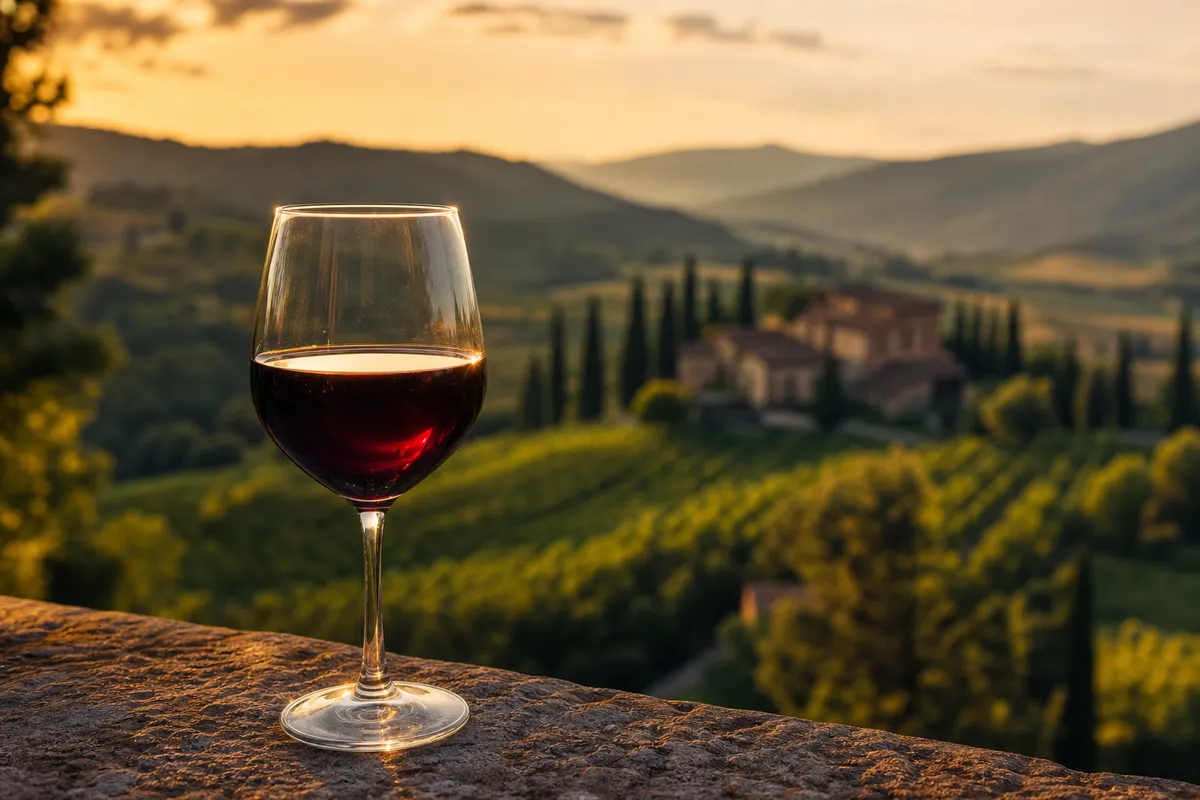
For wine, the whole municipality belongs to the Todi DOC grape area alongside Todi, Massa Martana and Collazzone. Only a delimited part of the town is included in the Colli Martani DOC and the Colli Perugini DOC, so those two names apply to some vineyards and not others. Ask the producer which denomination is on the label.
The municipality also sits within the broader protected-food geography of Pampepato di Terni IGP, the spiced Christmas sweet of Terni, and within the areas for Vitellone Bianco dell'Appennino Centrale IGP beef and Agnello del Centro Italia IGP lamb.
Doglio, Madonna del Piano and the countryside
Beyond the walls, the statistical map of the municipality counts six locality records: the centres of Doglio, Madonna del Piano and Monte Castello di Vibio, the small nuclei of Molino Ciani and Spineta, and scattered houses in the countryside. Doglio and Madonna del Piano are the two official frazioni.
More of Umbria

A letter from Italy, once a month.
The places, tables and makers we found worth your time. One email, no noise.
One letter a month. Unsubscribe at any time. We never share your address.