

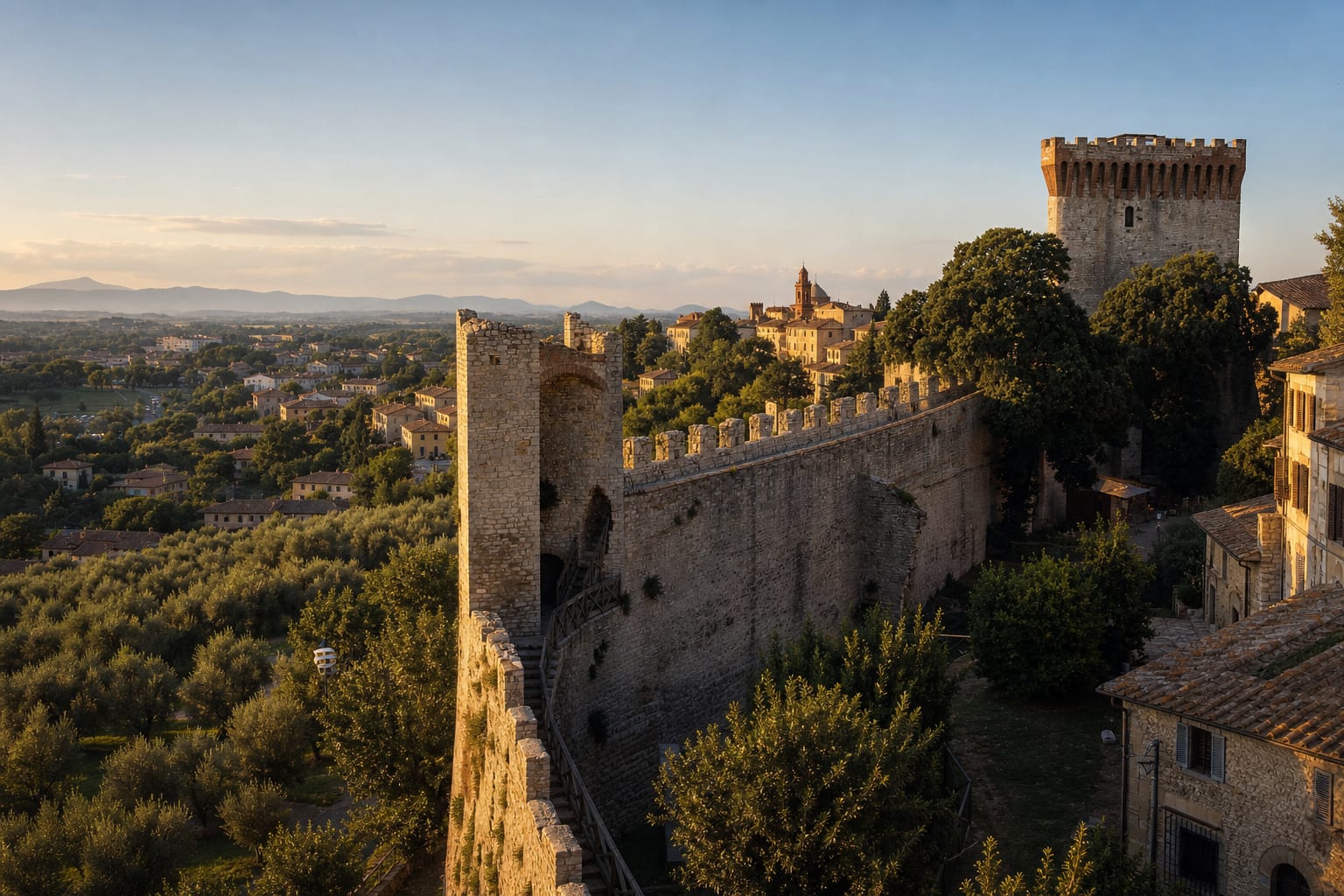
Set on a promontory above Lake Trasimeno, Umbria's largest lake, Castiglione del Lago looks out over reed beds and islands from behind its medieval walls and fortress.
It is a quiet base for boat crossings and lakeside evenings.
Castiglione del Lago in brief
The municipality is far larger than the town. It spans about 205 square kilometres and names twelve frazioni: Badia, Casamaggiore, Gioiella, Macchie, Panicarola, Petrignano del Lago, Piana, Porto, Pozzuolo, Sanfatucchio, Vaiano and Villastrada. The historic centre on the promontory is the capoluogo, not the whole municipality.
Between the Trasimeno shore and the Valdichiana ridge
The Comune describes two broad landscapes. Low or gently rising ground runs along the western shore of Lake Trasimeno, while a hill system divides that shore from the Valdichiana and the Tuscan lakes of Chiusi and Montepulciano. Piana, Sanfatucchio, Macchie and Panicarola lie in the shoreward zone. Petrignano del Lago, Pozzuolo, Casamaggiore, Porto, Gioiella, Vaiano and Villastrada occupy the western hill sequence, with Badia between the two.
To the south the municipality borders Panicale and Paciano, to the southwest Città della Pieve, to the west the Tuscan municipalities of Chiusi and Montepulciano, to the northwest Cortona, and to the north Tuoro sul Trasimeno.
The promontory is part of the lake's physical history. The Comune describes it as once surrounded by water, before alluvial deposits joined it to the mainland, which explains the abrupt meeting of walls, slope and lake that you see from the shore.
Lake Trasimeno and its park
The regional Lake Trasimeno Park covers about 13,200 hectares across Castiglione del Lago, Magione, Passignano sul Trasimeno, Tuoro sul Trasimeno and Panicale. It protects a lake system shared by five municipalities rather than a park belonging to a single town.
Bathing water in Italy is classified area by area, and the Ministry of Health's bathing-water portal lists the designated areas with their classifications, sampling results and prohibitions. Check the named bathing area there before you swim.
Hannibal, Etruscans and Perugia
Older layers lie beneath the medieval town. Official accounts place the fortress on an Etruscan acropolis with a visible stretch of ancient wall, and on Polvese remains in opus reticulatum show that Romans settled the island.
The medieval chapter began in the second half of the thirteenth century, when Perugia started building the Rocca Medievale. The fortress was a strategic point for watching both the lake and the approaches towards Chiusi.
Isola Polvese and the other islands
Lake Trasimeno has three islands, and only one belongs to Castiglione del Lago. The Comune states that the whole of Isola Polvese lies within its territory. Isola Maggiore is associated with Tuoro sul Trasimeno, and Isola Minore is private; a ferry link between Castiglione and Isola Maggiore does not change that.
Olive growing developed on its fertile ground, and owners in the last century restored the buildings and cared for the native vegetation, which gives Polvese the look of a natural garden. The landmarks are the church of San Giuliano, the monastery of San Secondo, the castle and the Piscina Porcinai.
Palazzo della Corgna and its fresco rooms
Palazzo della Corgna is both a monument and a working civic building. It was built from 1563 around the earlier Baglioni palace. The design has long been linked to Galeazzo Alessi, with Vignola also named, and the attribution has never been settled.
The first-floor museum route holds eight frescoed rooms painted between 1574 and 1590 by a team led by Niccolò Circignani, called il Pomarancio, after Diomede della Penna della Corgna commissioned the work in 1574.
The route opens with the Room of Paris, where the vault shows the Judgment of Paris, ringed by octagons of Hercules, Diana and Endymion, Perseus and Andromeda, and Pyramus and Thisbe, and commemorates Diomede's marriage to Porzia Colonna. The Room of Ascanio's Deeds celebrates the dynasty's founder with sixteen simulated tapestries of his campaigns, from the siege of Genoa to the Battle of Lepanto, and a vault in which Pope Julius III gives him the staff of Guardian of the Church. Diomede's bedroom, the Phaethon Room, shows the fall from Apollo's chariot among dawn, noon, sunset, night and the seasons, a warning against overreaching ambition. The Aeneid Room follows Virgil, painted by Circignani and Giovanni Antonio Pandolfi.
In the Gods Room, Jupiter presides from the skylight among the Olympians and the signs of the zodiac. The Room of the Battle of Trasimeno, the chamber of Ascanio II, shows the clash of 217 BC as its central scene. The Room of Pluto and Proserpina, the apartment of Laura della Corgna, Ascanio's sister, recounts the abduction of Proserpina and celebrates Laura's part in the family's continuity through her son Diomede. The last room, Diomede's study, was decorated in 1589-1590 by Salvio Savini with the life of Caesar after Suetonius, from the Gallic campaigns and the crossing of the Rubicon to Pharsalus and the assassination.
The Rocca Medievale, known as Rocca del Leone
A covered corridor reached from the eastern wall of the palace leads to the fortress, which you enter through Palazzo della Corgna. The Rocca has an irregular pentagonal plan, a triangular tower 39 metres high and four further towers. Two circular towers were added in the first half of the sixteenth century because round walls stand up better to artillery.
Inside the walls stand the ruins of a church of Saints Philip and James, probably of Byzantine origin and possibly built over an Etruscan temple. The fortress itself rises on an Etruscan acropolis, and a stretch of ancient wall is still visible. The official accounts choose their words with care (probably, possibly), and it is worth keeping that care when you talk about what you are looking at.
Churches and living worship
Santa Maria Maddalena is the parish church, in Via Vittorio Emanuele, with the attached churches of San Domenico Soriano, Madonna del Vitellino and Madonna del Soccorso. The parish church was closed for two years because of unstable capitals and reopened on 29 March 2026.
These are places of living worship first and landmarks second, so visit them quietly and with respect for the people using them.
Archaeology beneath the postcard view
Castiglione del Lago is an active research landscape rather than a finished archaeological story. Since 2015 the Trasimeno Regional Archaeology Project has surveyed and excavated within the municipality in agreement with SABAP Umbria and the Comune, and a 2023 scholarly report summarizes the fieldwork so far.
Older ministry material names finds from Gioiella, La Lucciola di Panicarola and Porto di Castiglione del Lago in a regional exhibition on the Etruscans of the Trasimeno.
Fish, beans, wine and oil of the lake
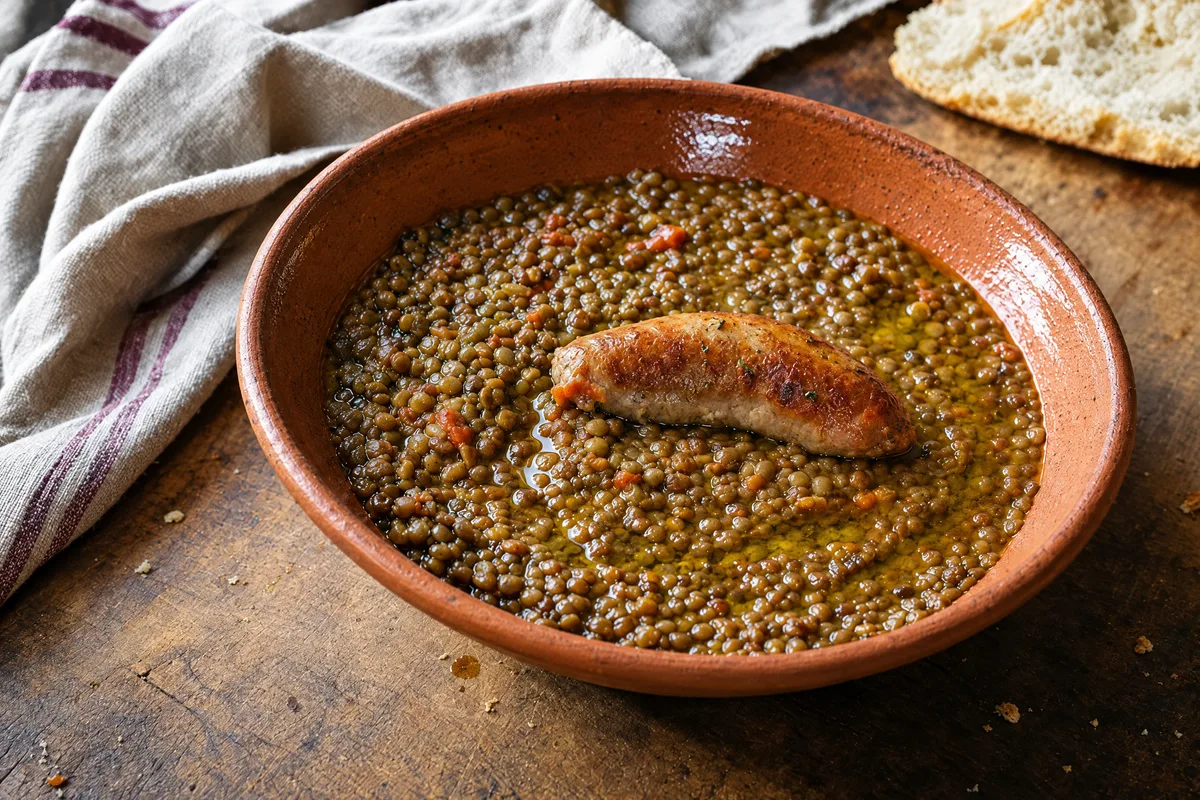
Two land products carry the same traditional label: the tiny Fagiolina del Lago bean and the Broccoletti del Lago.
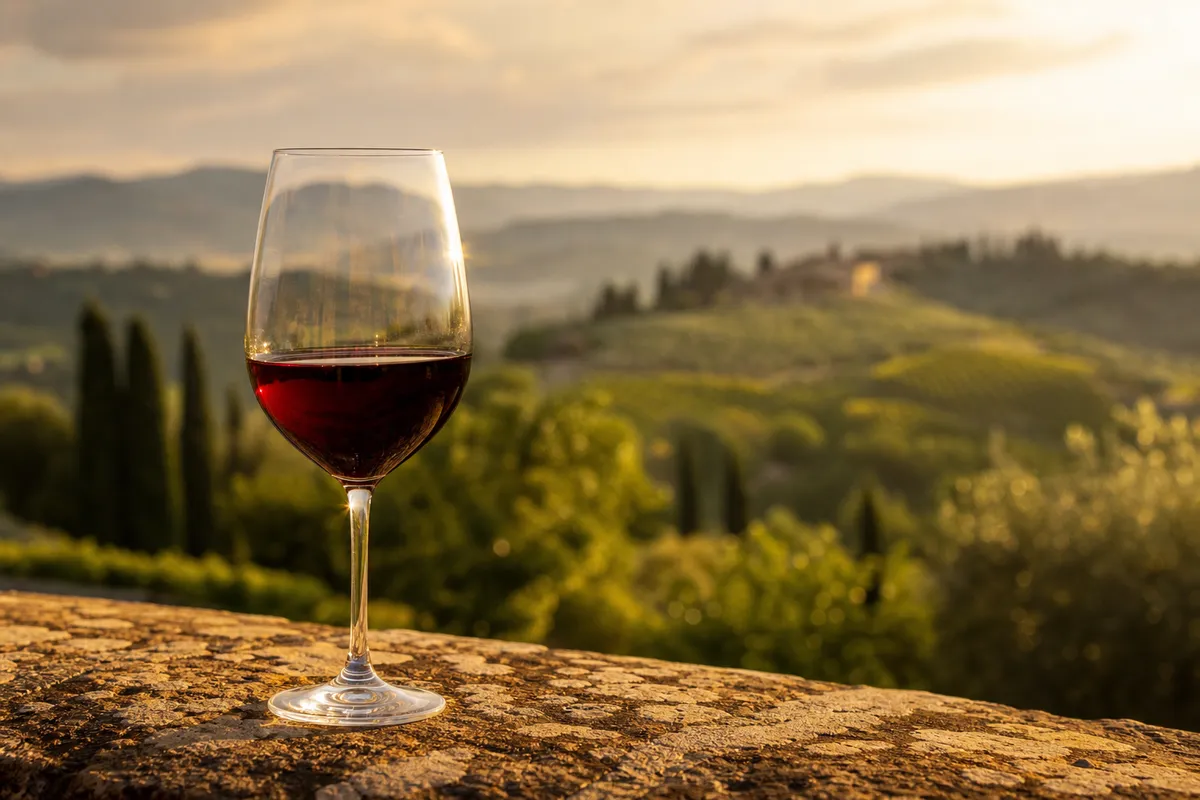
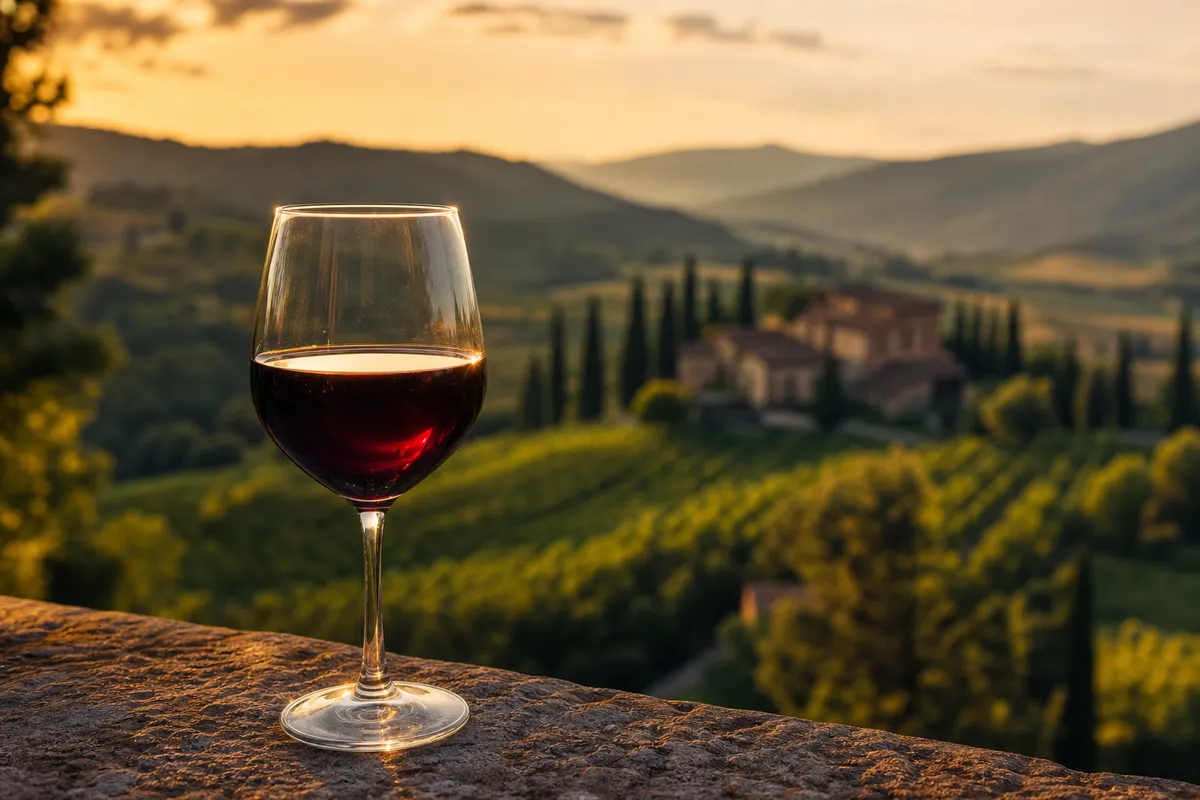
Colli del Trasimeno, or Trasimeno, is a registered wine denomination, and its recognised producer group has its address in Piazza Gramsci, Castiglione del Lago. The whole municipality also falls within the Colli del Trasimeno geographical mention of Umbria DOP olive oil, and within the production area of Pecorino Toscano PDO.
Accessibility around the old town
The Comune states that the palace museum route has no architectural barriers, while access to the towers does, so the fortress is not a step-free continuation of the palace.
More of Umbria

A letter from Italy, once a month.
The places, tables and makers we found worth your time. One email, no noise.
One letter a month. Unsubscribe at any time. We never share your address.