Magro
- Fat in dry matter
- Less than 20%
Valle d’Aosta Fromadzo is a DOP cheese made from partly skimmed cow’s milk, with a small addition of goat’s milk permitted.
The national decree of 25 September 1995 recognized the cheese’s denomination and set out its production characteristics.
European DOP protection followed in 1996. These dates establish the modern legal identity; they do not date the invention of every local cheesemaking practice or prove a continuous medieval recipe.
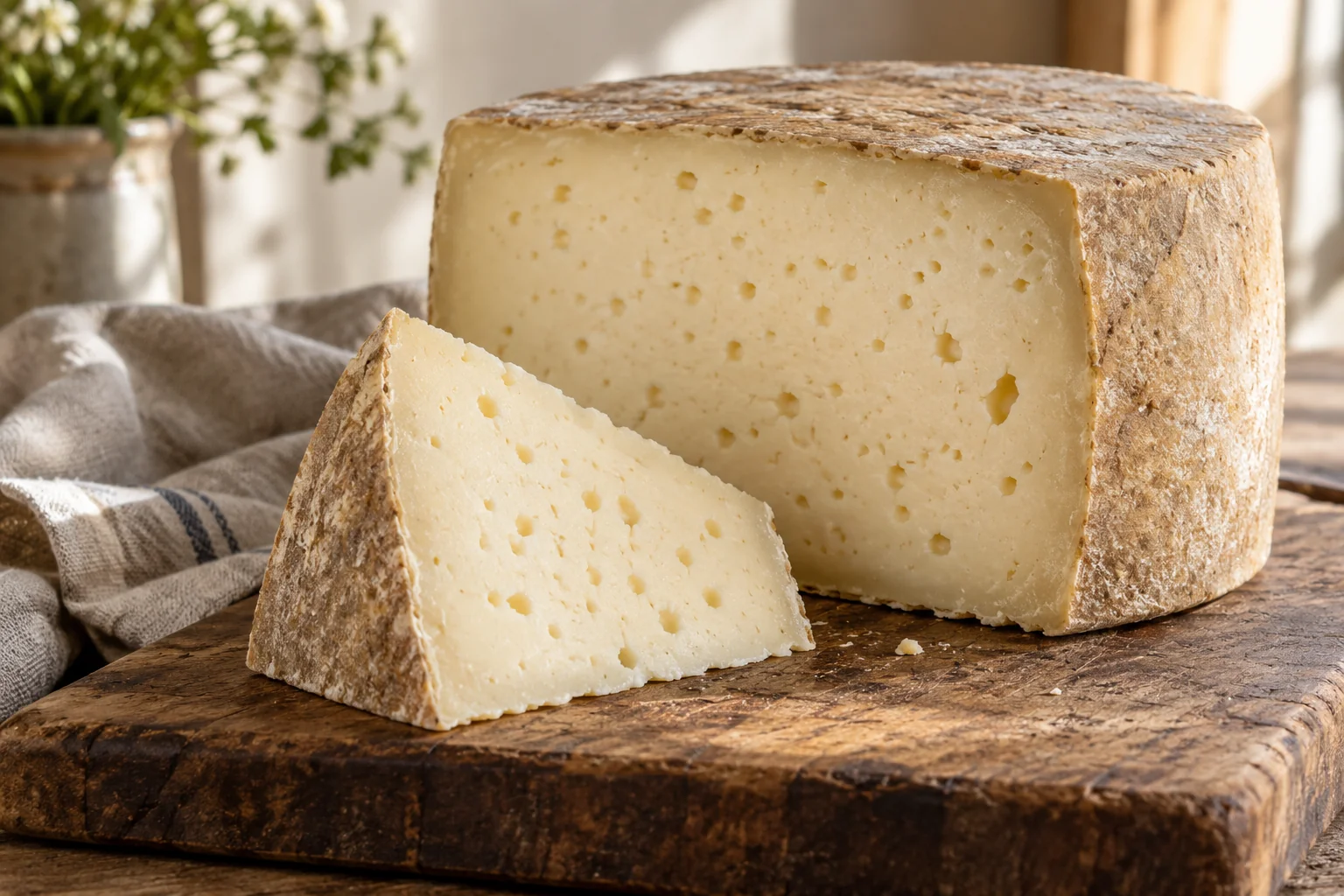
After the different natural-creaming rests, the milk is coagulated at 34–36 °C with natural rennet. The rule allows spontaneous dairy microflora and optional local cultures. The curd is cut and heated to no more than 45 °C, then placed in forms or baskets; light pressing may follow. Young wheels are turned, salted dry or in brine, and cleaned with water and salt during maturation. These steps explain why type and texture cannot be guessed from a single picture. The independently supported maturation minimum is 60 days. The temperature and humidity figures in the decree describe professional maturing rooms, not home storage. A particular dairy’s sequence and an individual wheel’s declared age require operator records.
The legal milk-origin and production geography is the entire Autonomous Region of Valle d’Aosta. That is broader than Aosta city or a single side valley, and narrower than the neighboring Alpine territories. The specification also requires fresh or dried local forage to predominate in feeding. It does not verify a detailed breed list, an exclusively local ration, or permanent summer grazing for every herd. The distinction matters when an appealing pasture image is placed next to the cheese: scenery can help a reader imagine the region, but only a traceable wheel and its production records identify the product.
Aosta ValleyServe shorter-matured Fromadzo as a table cheese; longer-matured examples are also sometimes grated. Compare labeled magro and semigrasso side by side, or plain and aromatic examples, keeping their age and milk statements visible. Judge the differences in the actual pieces you taste. The paste is compact, with scattered small or medium eyes, and the flavor becomes more pronounced with maturation. Try a small amount of a longer-aged piece grated over a finished dish, checking the texture of the cheese you have chosen.
Start with the complete protected name, then inspect the present package or ask the seller to show the provenance of a cut piece. The national recognition decree requires a distinguishing mark when the cheese enters consumption; the current retail presentation should be checked on the actual product. Color, herbs or the word “mountain” alone cannot authenticate it. For a meaningful comparison, ask for the magro or semigrasso class, cow-only or mixed-milk statement, optional aromatics, producer, declared age and lot where supplied.
Fromadzo is a milk cheese, and a particular wheel may include both cow’s and goat’s milk. The package gives its ingredient and allergen statements, date, nutrition information and storage directions. Follow those directions and protect the cold chain after purchase. The decree’s aging-room temperature is not a domestic refrigerator setting. A sealed portion, a counter-cut piece and a whole wheel have different handling histories, so ask the seller about a cut piece and use the producer’s directions for a packaged one. Optional aromatic plants belong to the exact product declaration, not to an assumption based on visible flecks.
No; a small addition is permitted, not compulsory.
No; they are specification classes expressed as fat in dry matter, not a serving-size panel.
No; aromatic plants are optional.
The places, tables and makers we found worth your time. One email, no noise.
One letter a month. Unsubscribe at any time. We never share your address.