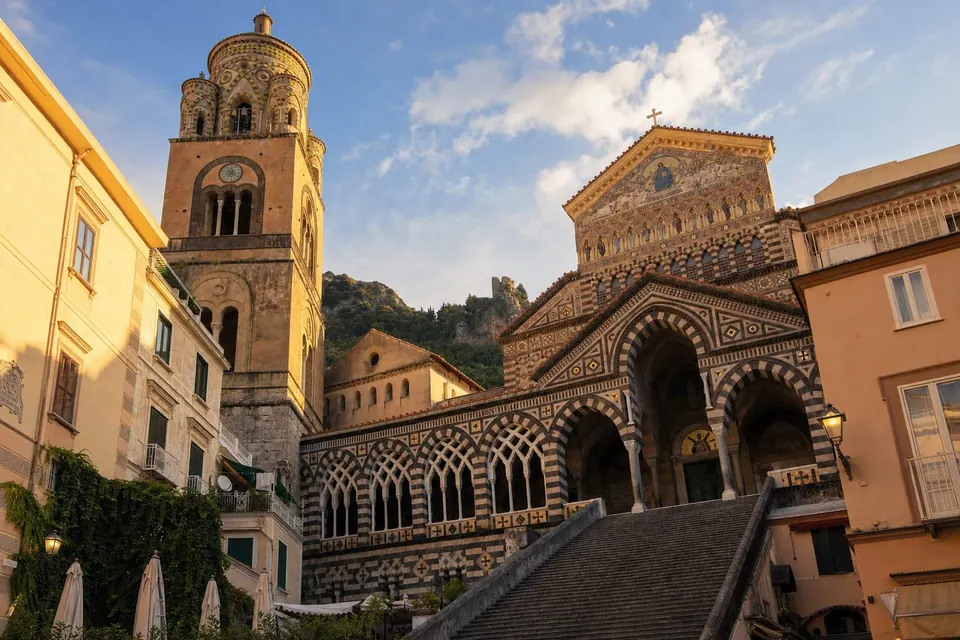
Amalfi's cathedral, dedicated to Saint Andrew the Apostle, dates its foundation to 987, when the maritime republic was near its peak, with a major enlargement in the early thirteenth century tied to Cardinal Pietro Capuano, the Amalfitan who brought Andrew's relics from Constantinople in 1208 and laid them in the crypt below. The bronze entrance doors, cast in Constantinople around 1066, are among the oldest in Italy. What visitors see from the piazza, a striped Moorish-Byzantine facade with a green-and-yellow majolica bell tower, is largely a nineteenth-century rebuild after the original collapsed in 1861. Beside it, the Chiostro del Paradiso, built in 1266-1268 as a noble burial ground, wraps interlacing Arab-Sicilian arches around a garden of palms.
A layered medieval cathedral complex whose related spaces record Amalfi’s ecclesiastical and funerary history.
Sources and citations (2)
- Comune di AmalfiMonumental Complex of the Cathedral of Sant’AndreaComplex overviewRead source
- Museo Diocesano di AmalfiChiostro del ParadisoCloister historyRead source