

Skip to content

Spiny Sardinian artichoke

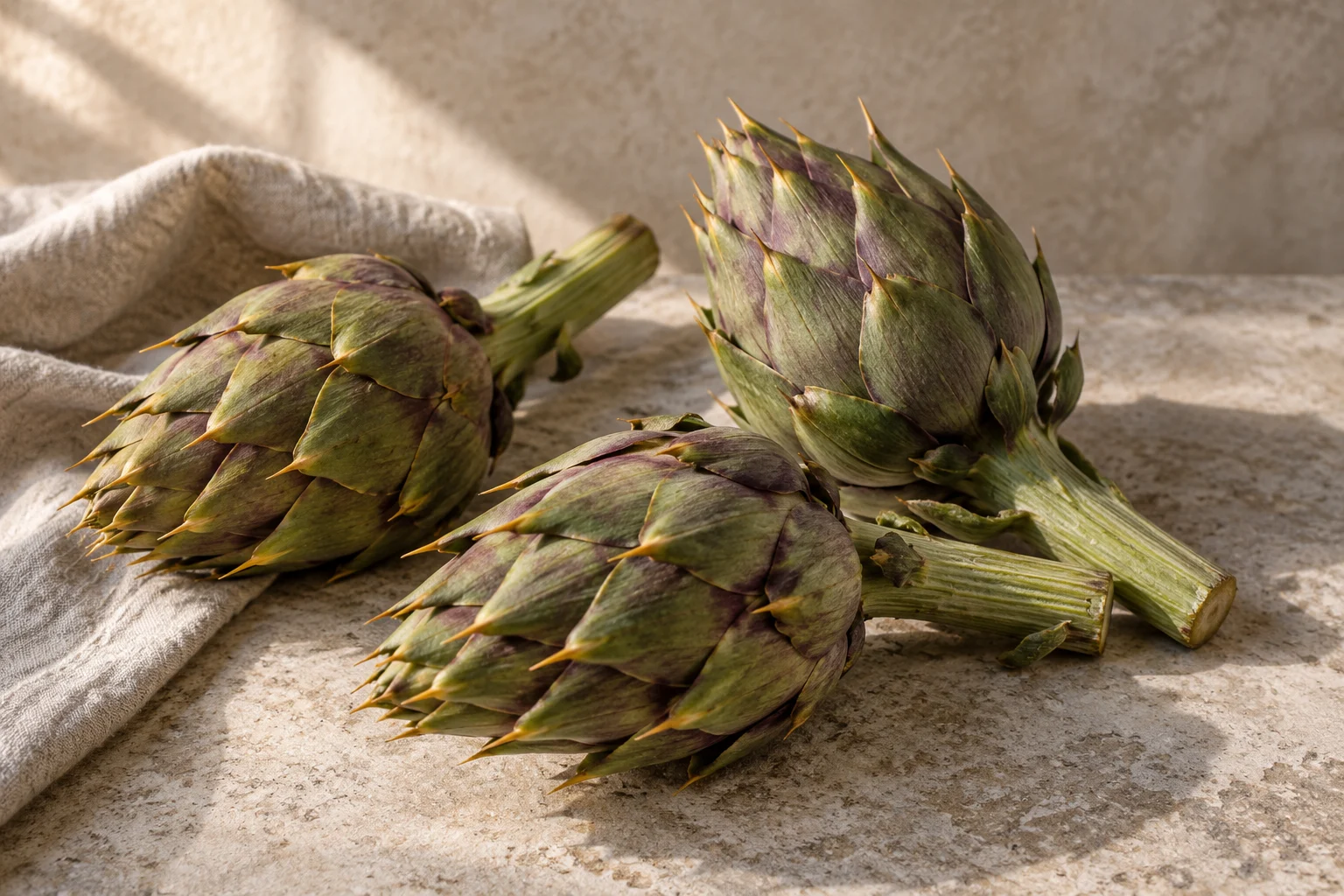
Carciofo Spinoso di Sardegna PDO is the local Spinoso Sardo artichoke, with conical heads, yellow spines and a tender inner stem.

Protection
PDO
Region
Sardinia
Characteristics
Conical heads with yellow spines

Beyond the yellow spines

The pointed head gives Spinoso Sardo its profile, but the tender inner stem deserves attention too.

A conical head, green bracts sometimes shaded violet-brown, and yellow spines distinguish this Sardinian artichoke. Inside, the bases of the bracts are described as both fleshy and crisp. Its flavor brings together bitter and sweet notes, with a thistle-like, floral aroma.

The stem is part of the story: its inner portion is tender, edible and relatively low in fiber. The specification explicitly records traditional raw consumption of both head and stem. The sharp exterior and the tender edible parts belong to the same artichoke.

Cut before the bracts open

The local Spinoso Sardo ecotype is grown in open fields and propagated from basal shoots or dormant buds originating in the defined production area. Harvesting is by hand, before the bracts open, within the September 1–May 31 window.

Conditioning and packaging take place in the defined Sardinian area. Conditioning can remove the woody outer stem, outer bracts and spiny tips while preserving the edible head. The specification emphasizes prompt handling after harvest to protect freshness.

A defined area across Sardinia

The PDO covers named municipalities across the island, rather than every field in Sardinia. The specification describes suitable coastal areas, valleys and central plains, linking local cultivation knowledge with the soils and climate.

Sardinia

Try it in the kitchen

Both the head and the tender inner stem can be eaten raw. After careful trimming, slice them finely and dress with olive oil and lemon.

Recognize the protected name

For a purchase tied to this origin, look for the full name “Carciofo Spinoso di Sardegna” with the PDO indication. A similar name or variety alone does not establish this protected origin.

Questions worth asking

Can the stem be eaten?

Yes. The specification describes the inner stem as tender, edible and low in fiber, and records its traditional consumption raw alongside the head.

Why are the tips so pointed?

The local Spinoso Sardo ecotype has elongated bracts ending in yellow spines. Their presence is part of the specified appearance.

Is every Sardinian artichoke a PDO product?

No. Carciofo Spinoso di Sardegna PDO must use the specified local ecotype, come from the named production municipalities and meet the production rules.

A letter from Italy, once a month.

The places, tables and makers we found worth your time. One email, no noise.

One letter a month. Unsubscribe at any time. We never share your address.

Help us get it right

What is it about?