Skip to content

Palazzo Vecchio

Florence's medieval town hall, still in civic use, with Vasari's Salone dei Cinquecento and Roman ruins beneath.

  • Florence
  • Palace
Where
Piazza della Signoria, Florence
Best for
Arnolfo's off-center tower
Allow
2 hours
Tickets
From €19
Checked September 2026

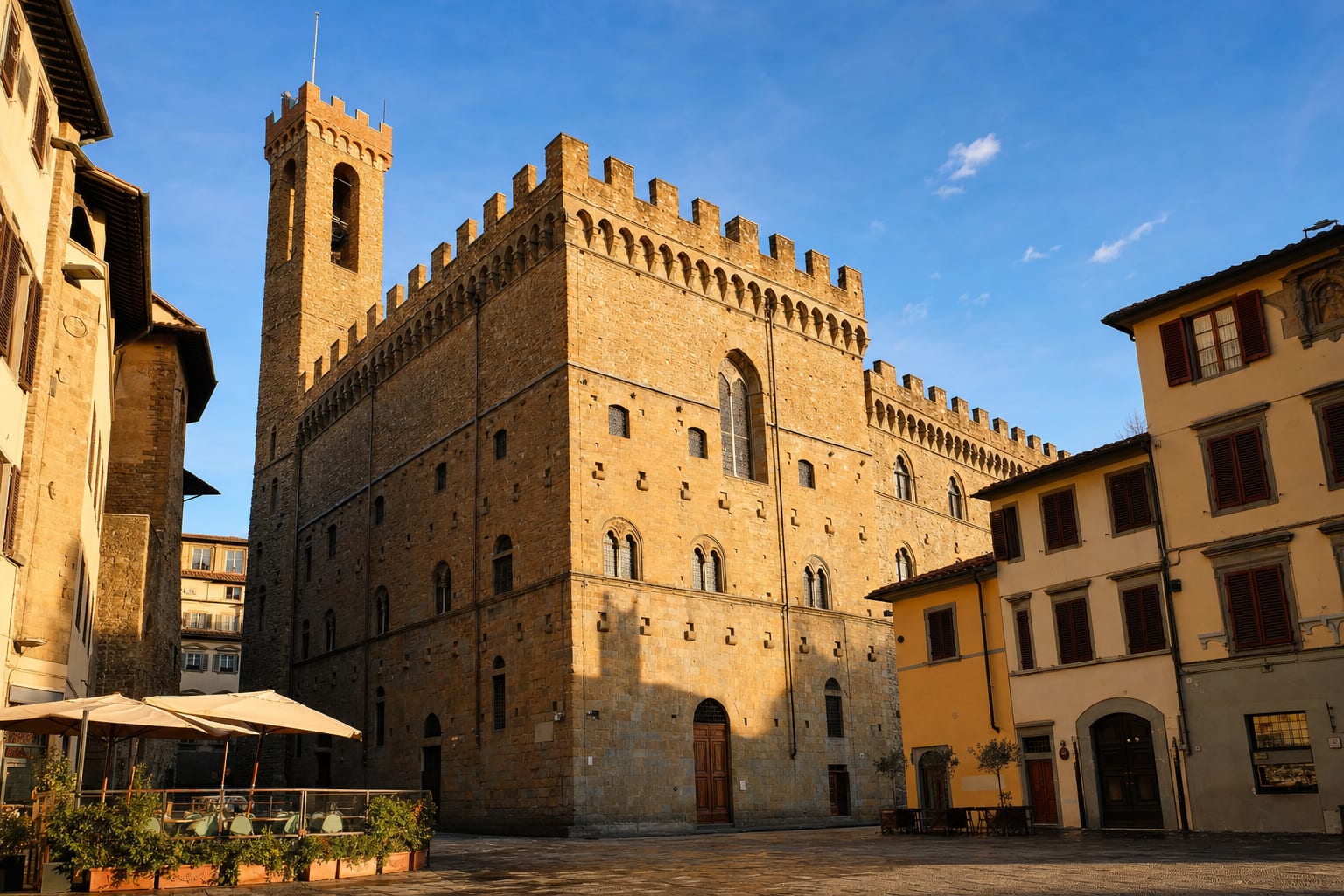
Palazzo Vecchio has served as the seat of Florence's government since 1299, making it one of the longest continuously used town halls in Europe; the mayor's office still operates from part of the building today. Arnolfo di Cambio designed the fortress-like original, its 94 meter asymmetric tower placed off-center because it incorporates an earlier Ghibelline family tower the builders refused to demolish. Cosimo I de' Medici moved in during the 1540s and had Giorgio Vasari transform the interior into the Salone dei Cinquecento, a vast hall built for Florence's short-lived republican council and later covered in Vasari's own propagandistic ceiling paintings glorifying Medici rule. Beneath the palace, excavated Roman theatre remains connect the building to the city's ancient foundations, a layered history visitors can walk through on themed tours.

Palazzo Vecchio records Florence’s civic government, later Medici transformation and continuing municipal presence. It is part of the Historic Centre of Florence World Heritage property, not a separately inscribed site.
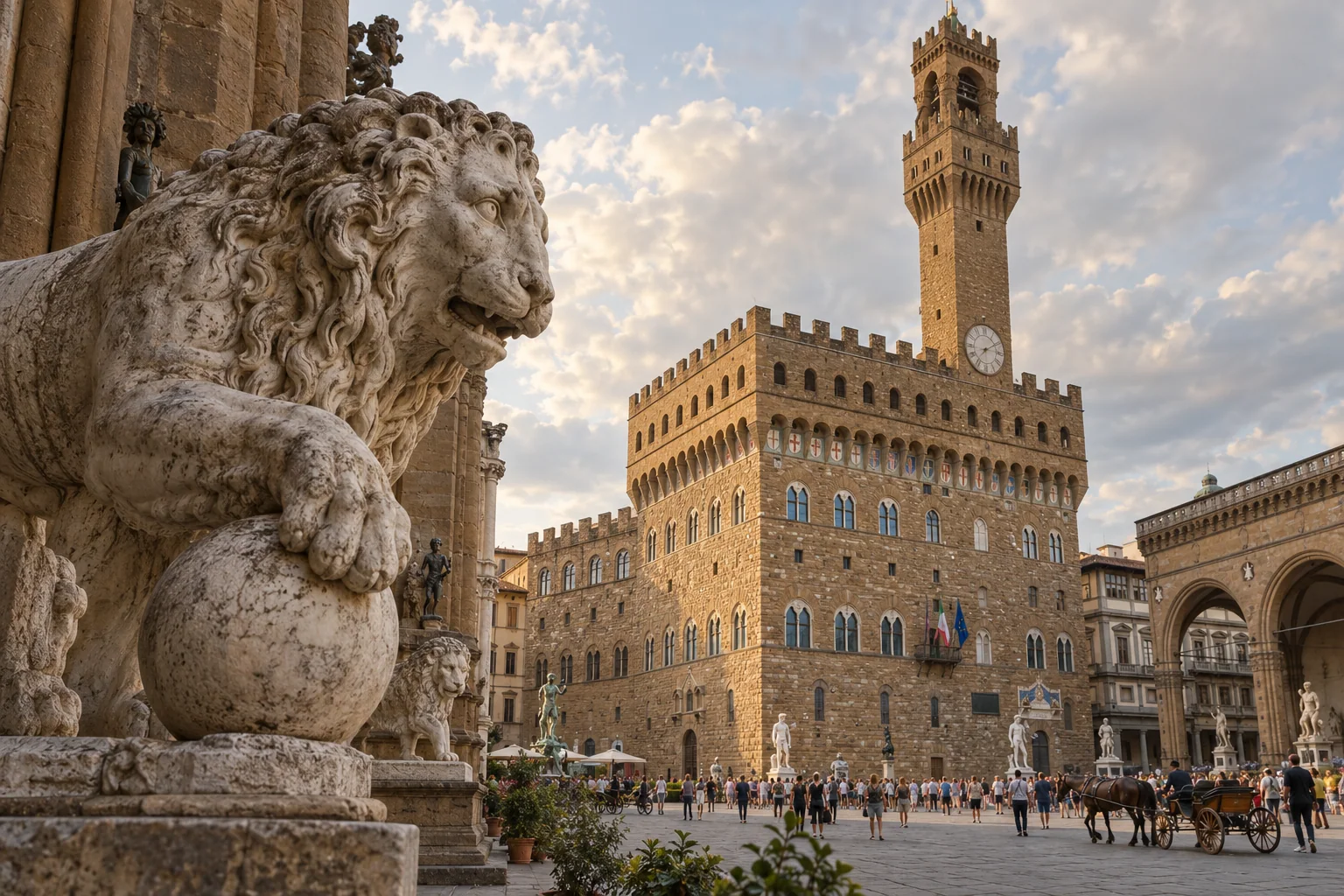
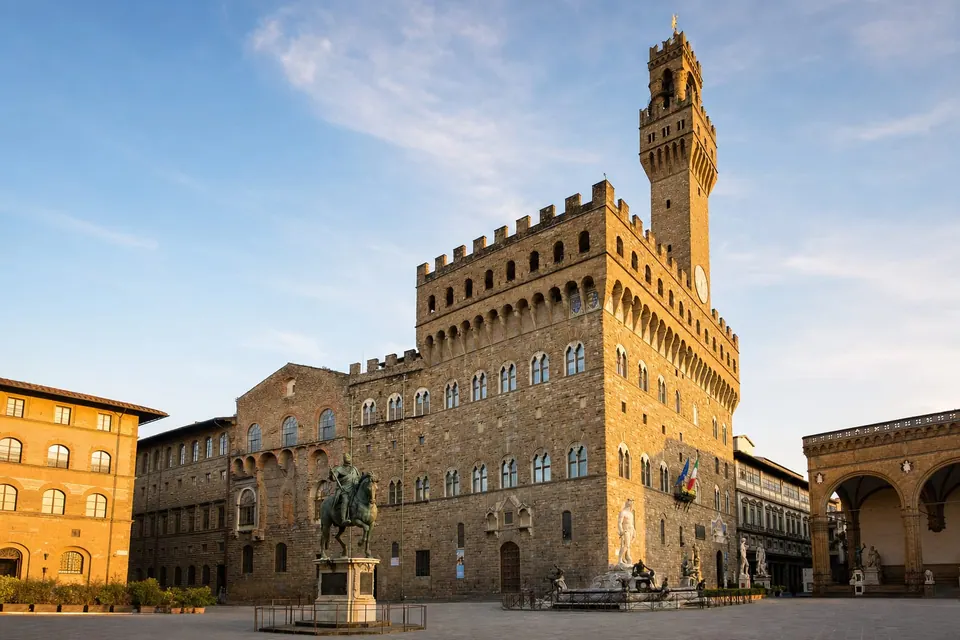
Palazzo Vecchio and its tall tower rising over Piazza della Signoria in late light
Rough golden stone, battlements and a tower set off-center, with the loggia and its statues at its feet.
Sources and citations (4)
  1. MUS.E FirenzeMuseo di Palazzo VecchioRead source
  2. Comune di Firenze, Musei Civici FiorentiniMuseo di Palazzo VecchioMuseum identity and historic namesRead source
  3. Comune di Firenze, Musei Civici FiorentiniMuseo di Palazzo VecchioOfficial museum tower summaryRead source
  4. UNESCO World Heritage CentreHistoric Centre of FlorenceRead source
Look closer

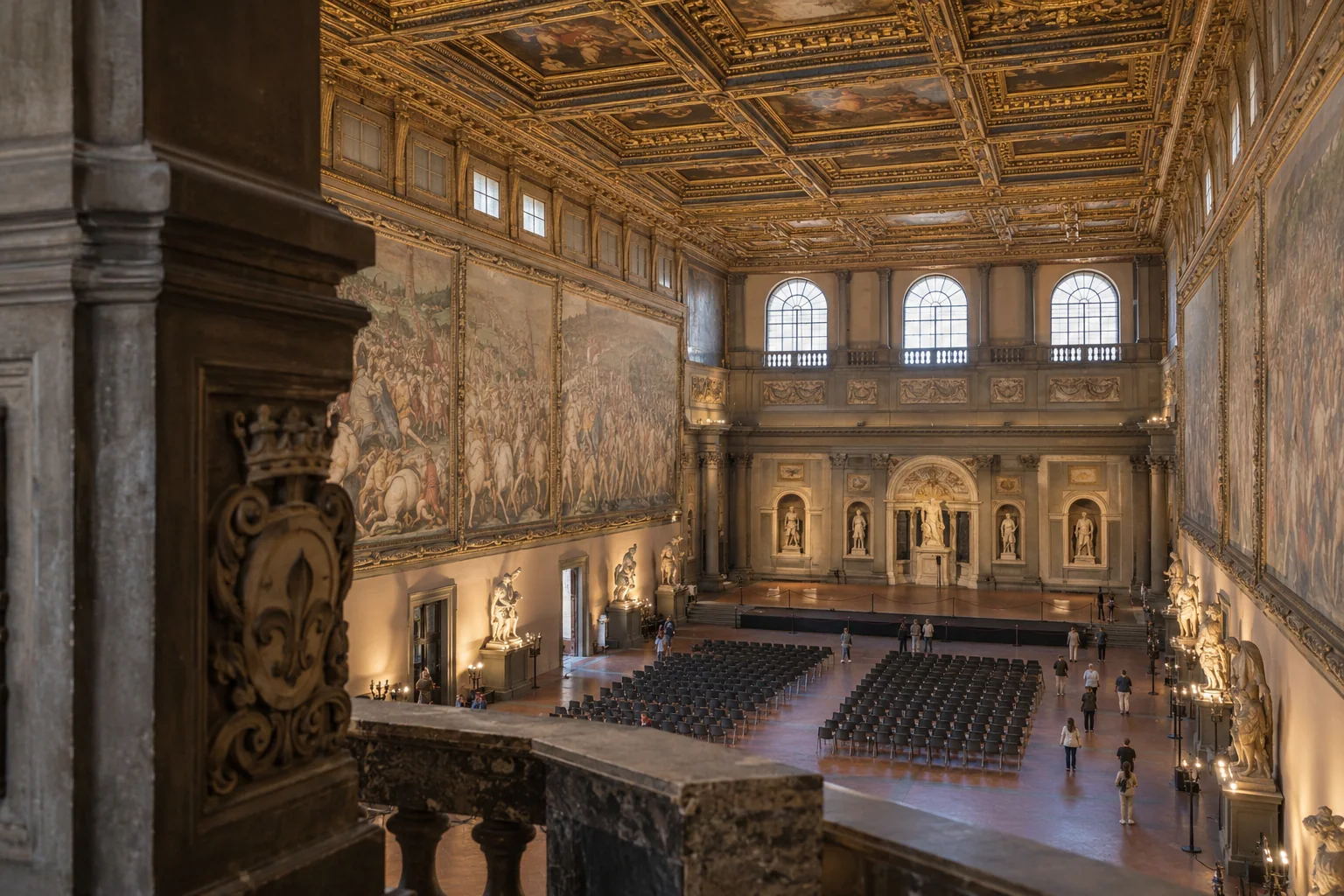
The Salone dei Cinquecento seen from the balcony, with its gilded ceiling and battle frescoes on the long walls
The great hallA council hall turned Medici stage: a deep gilded ceiling above, vast battle scenes down both long walls.
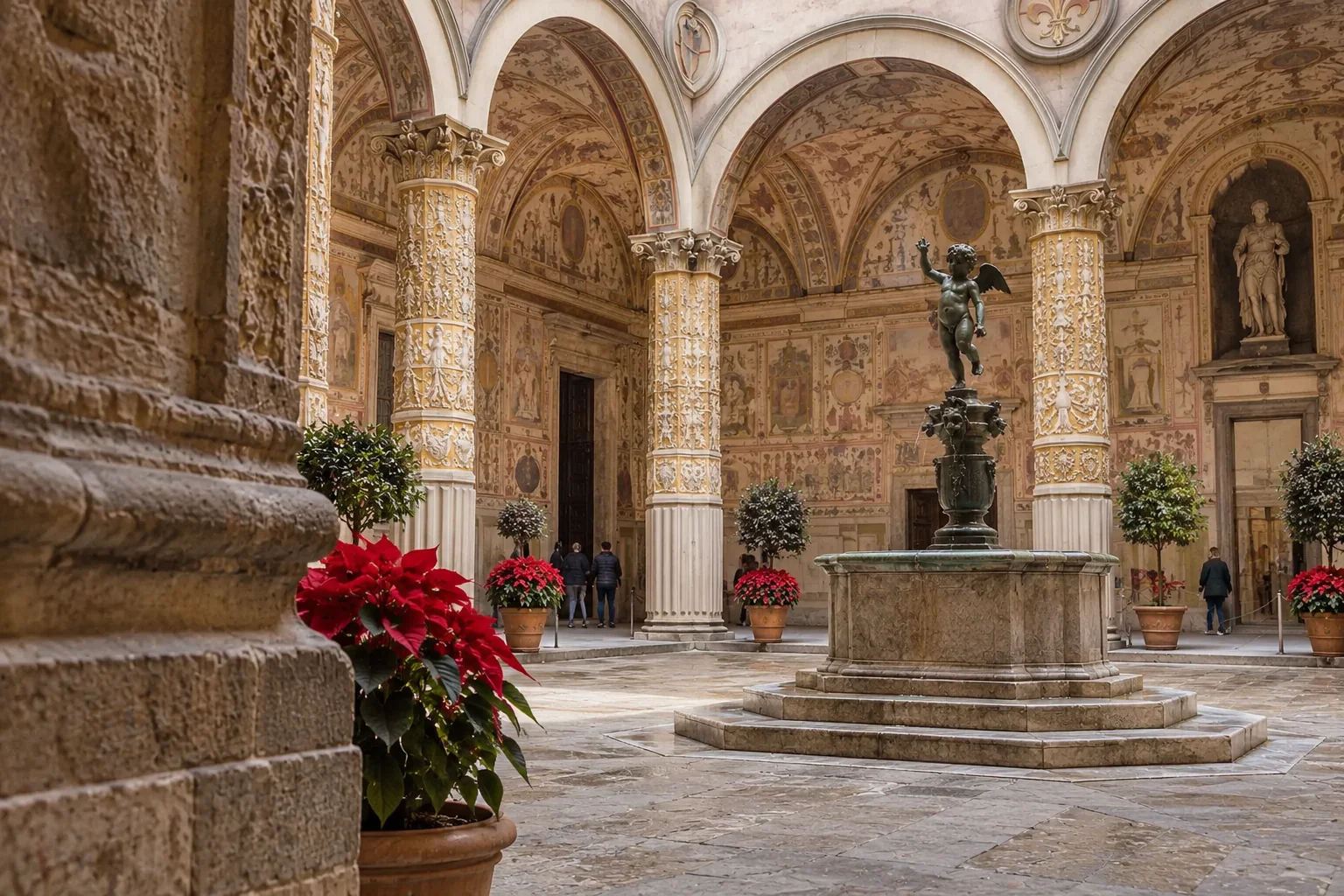
The first courtyard of Palazzo Vecchio with gilded stucco columns, painted vaults and a bronze fountain
The first courtyardColumns wrapped in gilded stucco and vaults painted with views of cities, around a small bronze fountain.
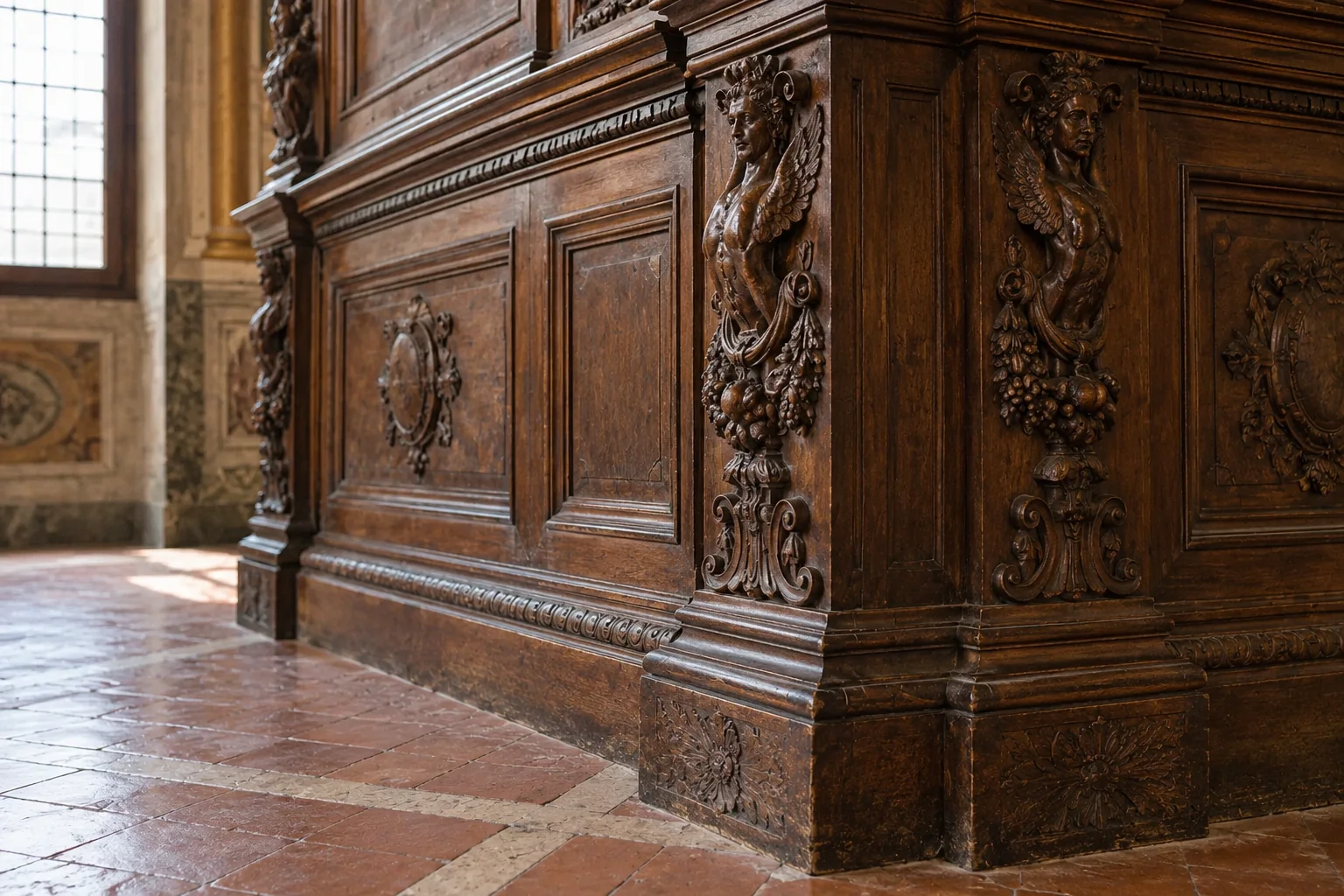
Dark carved walnut and terracotta flooring reveal the room’s material character.
Walnut in the Hall of MapsDark carved walnut and terracotta flooring reveal the room’s material character.

Five works worth finding

If you see nothing else, see these.

  1. Salone dei CinquecentoGiorgio Vasari

    A vast council hall turned into a Medici stage, its coffered ceiling glorifying Cosimo I; Vasari’s battle frescoes may conceal Leonardo’s lost Battle of Anghiari, a mystery still debated.First floor, main hall

  2. Genius of VictoryMichelangelo, 1532-1534

    A marble youth standing over a bent older man, originally planned for the tomb of Pope Julius II.Niche in the Salone dei Cinquecento

  3. Studiolo of Francesco IGiorgio Vasari, 1570-1575

    A windowless secret study whose walls and vault are packed with paintings, stucco and sculpture, a cabinet of curiosities in itself.Off the Salone dei Cinquecento

  4. Judith and HolofernesDonatello

    Donatello’s original bronze of the heroine raising her sword over the tyrant, placed here after restoration; a replica stands outside.Sala dei Gigli

  5. Hall of Geographical Maps

    Wall panels that map the world as the 16th century knew it, with a great globe at the center.Guardaroba rooms, beyond the Sala dei Gigli

Plan your visit

Everything you need before you go.

Tickets
From €19
Booking
No booking needed
Time needed
2 hours
Best time
Thursday morning, when the shorter opening hours mean noticeably thinner crowds.
Getting there
On Piazza della Signoria, a five minute walk from the Uffizi and the Duomo; the whole area is pedestrianized, so arrive on foot from a nearby garage.
Accessibility
The ground floor courtyard and main halls are accessible, but the tower and several upper rooms are reached only by narrow historic stairs.

Museum entry is about €19 adult, €13 reduced for EU citizens 18 to 24; under-18s free. The Arnolfo Tower climb and the Secret Passages guided tour are booked and priced separately, roughly €13 to €22 each. Last updated September 2026. Prices change, so check the official site before you go.

Book the Secret Passages tour if you can: it opens hidden staircases and a study built for Francesco I de' Medici that the standard ticket never reaches.

Get directionsGoogle MapsApple Maps

Piazza della Signoria, Florence

Tours worth booking

A few we would book ourselves, to get more from your visit.

Booking through these links may earn Italia Magnifica a commission, at no cost to you.

    • Viator
    • 1h 45m
    • 5.0★ · 19 reviews
    • Viator
    • 4h
    • 5.0★ · 19 reviews
    • Viator
    • 3h
    • 5.0★ · 41 reviews
    • Viator
    • 3h
    • 5.0★ · 49 reviews
    • Viator
    • 3h
    • 5.0★ · 48 reviews
    • Viator
    • 2h
    • 5.0★ · 25 reviews

Good to know

How long should you spend at the Palazzo Vecchio?

Two hours covers the main halls and the Studiolo, and another hour if you join a themed tour or climb the tower. It is worth doing slowly, because the rooms are layered with history.

Do you need to book the Palazzo Vecchio?

It is usually easier to enter than the Uffizi, so booking is optional, but it saves time in high season and for the guided routes and tower. Themed tours, such as the secret passages, do need reserving.

Can you see the Palazzo Vecchio and the Uffizi in one day?

Yes, they stand a short stroll apart on Piazza della Signoria. Do the Uffizi first while you are fresh, and the Palazzo Vecchio in the afternoon, when its halls are a change of pace from the paintings.

A letter from Italy, once a month.

The places, tables and makers we found worth your time. One email, no noise.

One letter a month. Unsubscribe at any time. We never share your address.

Help us get it right

What is it about?